Latest News on ISO 31000
The closing date for the International Ballot on Final Draft ISO 31000 passed and we have therefore removed the documents from our website.
The results of the ballot have now been announced. 26 countries, including the USA, China, UK, Canada, Australia and New Zealand voted for the standard. Only Italy voted against and Germany and Uruguay abstained. This means that the ISO standard will now go farward for publication without significant alteration.
It is expected that the ISO standard will be published after 9th October 2009.
|
|
Broadleaf have been closely involved in the development of risk management standard ISO 31000
Members of Broadleaf have played a major role in writing and supporting the Australian and New Zealand Risk Management Standard AS/NZS 4360 and its many handbooks since its inception in 1995.
The 2004 version of that standard has now been adopted by many organisations outside of Australia and New Zealand as the basis for their approaches to risk management. Accordingly, in 2005, the International Standards Organisation moved to create a global, ISO standard based on AS/NZS 4360:2004. |

Again here, through one of our Associate Directors, Grant Purdy, a nominated expert on the ISO Risk Management Working Group, Broadleaf continues to play a thought-leader role in the drafting of what will be the world’s first and paramount standard for risk management: ISO 31000 will be published around September 2009 along with a vocabulary for risk management contained in the revised ISO/IEC ‘Guide 73’.
On 10 September 2008, a live web-based briefing on ISO 31000, featuring Grant Purdy, was broadcast. The transcript can be accessed here. |

Principles for Managing
Risk
- Creates value.
- Is an integral part of organizational processes.
- Part of decision making.
- Explicitly addresses uncertainty.
- Systematic, structured and timely.
- Based on the best available information.
- Tailored.
- Takes human and cultural factors into account.
- Transparent and inclusive.
- Dynamic, iterative and responsive to change.
- Facilitates continual improvement and enhancement of the
organization.
|

This standard will apply to all organisations worldwide, to all risks and in all sectors. It will become the benchmark for good practice risk management, wherever an organisation operates and whether it is the private or public sectors.
With its new definition of risk as “the effect of uncertainty on objectives", ISO 31000 endorses the central, value-creating role that risk management plays. Broadleaf is now working with many major organisations helping them develop or revise their approaches to risk management, aligned to the new standard so that they are ‘future proofed’.
Broadleaf have provided a tutorial note "A Simple Guide to Risk and Its Management", which provides a clear overview of risk management, with the most up-to-date definitions and references to ISO 31000.
|
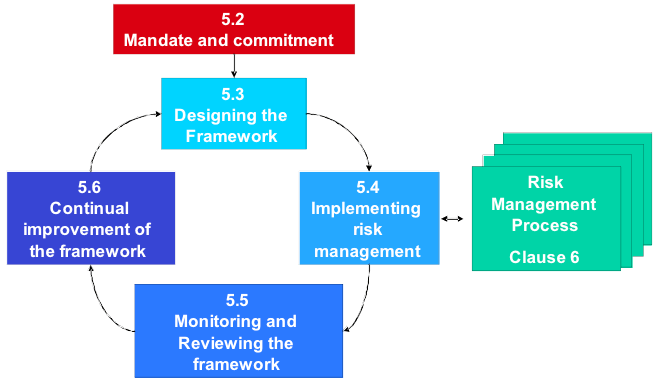
ISO
31000 Process for Developing and Sustaining a Risk Management
Framework
|
ISO 31000
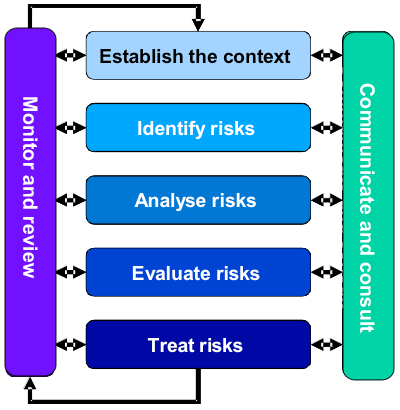
is based on the AS/NZS 4360:2004 risk management process, but
goes much further to define the principles against which organisations
can evaluate their approach to risk management and use the
standard to provide a road map for their future development.
Particularly for those companies and government bodies who
wish to practice Enterprise Risk Management, the new standard
sets out the practical approach to establishing and sustaining
a capable framework for the management of all the risks they
face.
|

Attributes of Excellence
- An emphasis on continual improvement in risk management.
- Comprehensive, fully defined and fully accepted accountability
for risks, risk controls and risk treatment tasks.
- All decision making within the organization, whatever the
level of importance and significance, involves the explicit
consideration of risks and the application of risk management
to some appropriate degree.
- Continual communications with internal and external stakeholders
including comprehensive and frequent reporting of risk management performance is part
of good governance.
- Comprehensive and frequent internal and external reporting
on both significant risks and on risk management.
- Risk management is viewed as central to the organization's
management processes so that risks are considered in terms
of effect of uncertainty on objectives
|
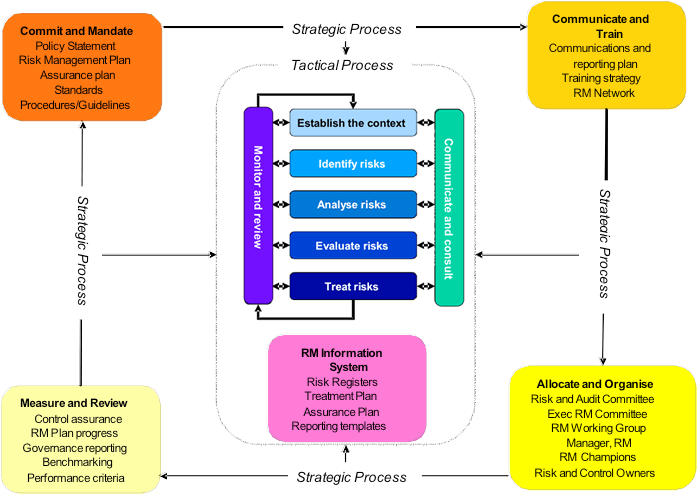
ISO 31000 Process for
Developing and Sustaining a Risk Management Framework
If you wish to plan
for your move onto the new standard, or just require a health
check on your existing approaches, Broadleaf is able to offer
a diagnostic, maturity evaluation and gap analysis that leads
to the formulation of a practical strategy for the future.
Our tutorial notes on ERM
and Governance Reporting contain much practical advice on how
organisations align themselves to ISO 31000.
Please feel free
to contact us for further advice and assistance.
|