Every project gives rise to fresh challenges and
presents us with new uncertainties. Not only is each project
unique, but budgets and schedules are invariably under pressure.
Projects are almost always risky
for their sponsors and might threaten the careers of those charged
with delivering them, so formal methods for understanding and
managing project risks are being used with increasing frequency.
We have set out examples of some common risks and the links
between them elsewhere on this site (see right).
The Importance of Cost-Effectiveness
Formal methods do not have to be complicated or time consuming.
They must be well founded though and implemented cost-effectively.
Ill conceived and ill informed attempts at risk management can
absorb substantial resources for little or no gain.
It is useful to divide risk management on projects into two
areas:
- Understanding the individual risks;
- Assessing the total risk that a project
represents to an organisation or business.
|
ON THIS PAGE 
Click anywhere in left
or right borders to return to the top of this page.

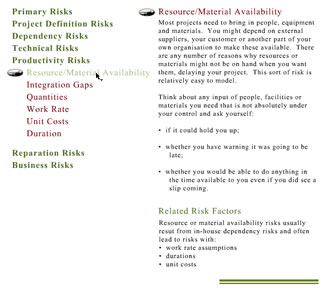
TYPES OF RISK
Click on the image below for an illustrative analysis of different
types of project risk, showing their inter-relationships and
our suggested ways of addressing them.

|
Individual Risks
To formulate plans for managing risks, it is necessary to identify
individual risks and then assess the priority they should be
given within the project.
This can often be achieved using qualitative assessment techniques,
drawing on quantitative information only when it is necessary
to clarify the likelihood or potential consequences of a risk.
A well managed risk assessment can show which issues a team
needs to focus on and help them develop strategies for addressing
the risks much more cost-effectively than informal or ad
hoc methods. |

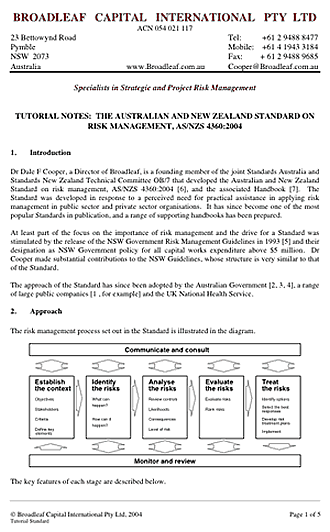
RISK MANAGEMENT OVERVIEW
Our tutorial on the Australia / New Zealand Risk Management Standard offers you an overview of the subject of risk management.
Just click on the image below to download it (40kb PDF).

|
We base our approach to risk identification, priority setting,
treatment and monitoring on the Standard AS/NZS4360 (see left).
A structured approach to brainstorming risks ensures that:
- effort is applied uniformly to all the areas requiring
attention; and,
- a meaningful result is produced
in the time allotted to the exercise.
The output of a risk workshop is a set of risks in priority
order, generally with someone's name against each of the most
severe.
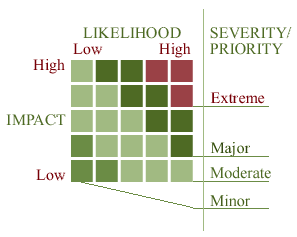
The severity of risks is assessed by evaluating their likelihood
and impact and using a classification matrix similar to that
illustrated below.
Risks are usually assembled into a risk register detailing:
- the nature of the risk;
- what measures are already in place to control it;
- the likelihood and impact of the risk;
- its priority based on that likelihood and impact;
- the name of the person responsible for monitoring and treating
it.
|
After the initial workshop, either as part of
their general duties or in another workshop, the team will develop
risk treatment plans. See the description of the Standard AS/NZS4360
(above left).
Risks will usually then be reviewed at regular project meetings
and subject to a major review every 6 to 12 months or at times
of significant change and disruption. |
Overall
Risk
An assessment can be made of the overall risk associated with
a project, generally in terms of its financial and schedule
targets, given a defined scope and plans. Models
can be used to represent individual uncertainties in terms
of probabilities and distributions and link them to the uncertainty
in the overall outcome of a project. These models are
generally evaluated using Monte Carlo simulation, for which
we usually use @RISK (see right).
Models simplify target setting and the establishment of realistic
contingency holdings.
The output of a risk model offers a sound basis for negotiating
commitments between customers and suppliers or between business
managers and project managers.
The results can also be used to weigh the risk of a project
against the general level of risk in an organisation's operations
as a whole.
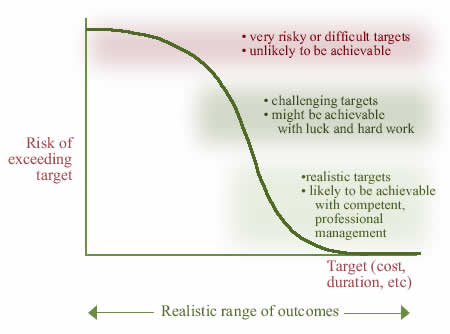
A typical risk model output is illustrated schematically below.
It shows the range of realistically likely outcomes for a measure
that you would generally want to minimise, such as the cost
or duration of a project, and the likelihood of exceeding a
target set somewhere in that range. |

Many of our services are based on Palisade products, including
@RISK. We are a Value Added Reseller for Palisade tools and we
offer training in their use. Click on the image below for further
information.


|
If you know what expectations already exist about a budget
or completion date, you can use this to decide whether they
are realistic.
If they are not realistic you might try to change the expectations
or alter the approach to completing the work to make it quicker
and cheaper.
If you have not yet bid for the work or decided to proceed,
you could also decide to put your resources into something more
likely to succeed.
This sort of analysis can be applied to measures other than
the cost and duration of a project. NPV, payback, IRR,
system throughput, productivity, cash flow over time and most
other numerical measures of a business or project can be examined
this way to help you understand and manage the uncertainty in
them.
For further information about range analyses for projects, please see these links which are also found on the Tutorials page:

|
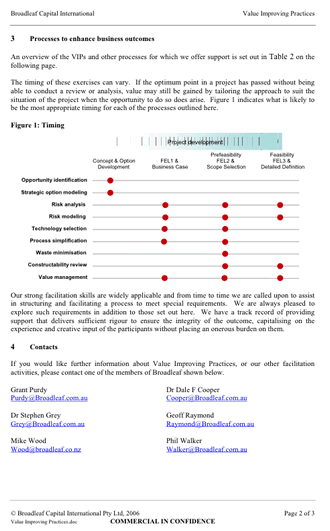
VALUE IMPROVING PRACTICES
Project risks may be significantly mitigated by implementing Value Improving Practices (VIPs) at the early stages of a project. Click on the image below for our PDF which explains the principles and processes of VIPs.
|

|





